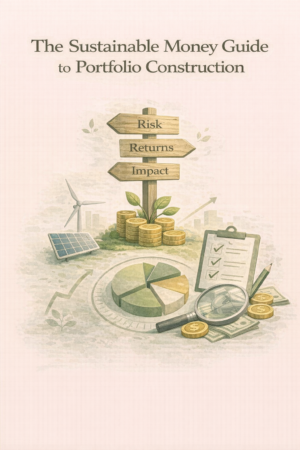
In this article we’ll cover how to build an investment portfolio that’s diversified, risk-aware, and aligned with a greener global economy. We’ll look at a step-by-step process that you can follow, and more importantly, implement.
Why Portfolio Construction Matters
Behind every successful investor lies a quiet framework. We call this framework “portfolio construction” and it is carefully designed to achieve the goals of the investor. At its heart, portfolio construction consists of the following steps:
- Define your goals: Are you investing for income or growth? Over what time period?
- Understand your risk appetite: Are you willing to accept bigger risks for potentially bigger gains or not?
- Diversifying your investments to reduce risk: Invest in assets across different sectors and geographical regions.
- Choosing the right building blocks: What mix of assets will achieve your goals?
- Keep costs low: Pick funds and a platform at reasonable costs.
- Staying the course and not reacting: Don’t panic and sell when the market crashes.
Whilst making solid investment decisions is important, if you have not defined your goals or risk appetite, it is likely you will not achieve the maximum potential you are hoping for from your investment portfolio.
Define Your Goals
Before taking the plunge and buying a stock, you must first clearly define your goal. From your goals, you can begin to identify what mix of assets is best to build out your portfolio. The below are questions you should ask yourself to help identify your goals.
The first question to ask yourself at the highest level is, “what do I want my portfolio to achieve?. The answer to this could be:
- Achieve growth
- Deliver income to live off in the form of dividends and interest
- A bit of both
Another question to ask yourself is, “how much money do I want to achieve?”. The answer could vary depending on why you are investing but could be one of the following:
- I want to build a £2,000,000 portfolio to provide a comfortable retirement and allow me to support my family.
- I want a portfolio that can return an annual income of £40,000,
- I am investing in order to save up for my children’s university fees over the next 15 years.
You can also frame your goals in the form of short, medium or long term.
Short-Term Goals (0–3 years): Typical examples of a short term goal would be building an emergency fund or saving for a house. The approach to achieve this would be low risk, utlising cash products and short term bonds. This would keep your portfolio liquid, and also low risk of being affected by market volatility.
Medium-Term Goals (3–10 years): Saving for university fees or planning for a future house move are good examples. Maintaining a balanced portfolio with equities and bonds would be a sensible approach with some protection from lengthy market downturns.
Long-Term Goals (10+ years): Saving for retirement or planning for a generational wealth transfer are examples of long term goals. High exposure to equities to drive growth is an acceptable strategy here, with a view that you are happy to wait out long market downturns.
In summary, ask yourself:
- When do I need the money and how long can I go without needing it?
- Can I wait out any market downturns? Or can I not?
- How does my appetite to invest sustainably compare to my desire for returns?
Understanding Risk (in a Sustainable Way)
Risk is a critical concept in investing that all investors must understand. It is about understanding that your investments may fall in value and not deliver the returns you set out to achieve. The general philosophy is that risk is directly linked to potential reward, in other words, the bigger the potential profit, the bigger the risk you will lose some or all of your money.
There are several types of risks involved with investing and different ways to mitigate these risks. Without this guide turning into a text book on investment risk, here are some basic principles to understand if you are new to investing.
- Market risk: The value of your investments, particularly equities, can go up as well as down, sometimes significantly. You must mitigate market risk by diversification of your investments across a variety of sectors and geographical location.
- Inflation risk: This is the risk that the rate of inflation outpaces the growth of your investments. In other words, keeping your money as cash in a bank account might seem safe, but if inflation is higher than the interest you are earning, the value of your money is actually decreasing over time. Therefore diversification across a range of asset classes is required.
- Climate/Transition Risk: Whether your investing goals have sustainability goals or not, climate and transition risk need to be factored into your long term investing. Specific points to consider:
- Carbon pricing – In some countries high polluting companies can be hit with carbon taxes. There is no certainty as to how high these could rise in the future and how they could affect a company’s performance.
- Regulation – Governments are increasingly bringing in more “green regulation”. There is no way to tell how this will directly affect companies or investment products in the years to come. However it is a safe bet that funds that are already sustainable will be in a far stronger place to adapt to any regulatory changes that will come in the future.
- Physical climate damage – You also need to consider the direct physical damage that can be caused by the increasing number and intensity of natural disasters. If a firm has its infrastructure damaged due to a natural disaster, it will undoubtedly damage the company’s returns.
Diversification, dollar-cost averaging (setting up small regular contributions), portfolio rebalancing and focussing on the long term are all methods of reducing risk. Risk is more than just the potential to lose money, it’s ultimately about uncertainty. Your portfolio therefore must be designed to handle these uncertain risks.
Portfolio Building Blocks: Asset Classes
A solid portfolio is made up of different asset classes in varying proportions from varying geographical locations in order to achieve the desired goals and performance intended. The main asset classes (types of investment) for new investors to become familiar with are as follows.
Equities (shares/stocks): These are the building blocks of a portfolio that drive growth. Buying an “equity” means buying shares directly into a company. Your shares, or stock, can go up in value over time if the company performs well (and demand for shares also drives up the price). This is called capital appreciation. As a share holder, you are also entitled to profits of the underlying company and these are paid out in the form of dividends.
Bonds: Bonds are used to add some stability to a portfolio and are used for generating regular income. A bond is effectively a type of loan, by that I mean that you, the investor, is loaning money to a company or even a government (T-Bond in the USA, Gilt in the UK). In return, bond owners receive regular income in the form of interest. Bonds have an expiry date and are issued and subsequently redeemed at the same price, so whilst their value does vary on the secondary market, they are unlikely to significantly lose an investor money (unless the company goes insolvent).
Funds: As a retail investor, funds will likely form the bulk of your portfolio. Multiple investors can purchase “units” in a fund, which all goes to a fund manager. The fund manager then uses their expertise to pick the mix of equities and/or bonds to build their fund which may focus on growth (primarily equities), income (mainly bonds) or even provide a mixed fund. The fund manager charges an annual management charge on the investors which is a percentage. They do all the hard work researching different companies to invest in so you don’t have to!
Cash: Another important point to your portfolio is cash. Cash is 100% liquid, so always keep enough cash available for unforeseen immediate expenses. This doesn’t have to be idle however. Look for the accounts paying the best interest rates regularly. Tip: this will likely not be a major high street bank!
Asset Allocation: The Core of Portfolio Construction
Asset allocation is the mix of equities, bonds, funds and cash held within your portfolio which is determined by your overall goals and appetite for risk. Fortunately, there is a fairly standard way of splitting your assets depending on your goals and these are shown as follows with the three most common types of model portfolios.
Model Portfolio A — Cautious (30/70)
Risk level: Low
This is useful for either short-to-medium term goals, or those in retirement wanting to shift their focus to producing regular income.
- 30% Equities
- 70% Bonds
Model Portfolio B — Balanced (60/40)
Risk level: Moderate
Balanced portfolios are a great all round portfolio for those who require regular income but also still want to substantially grow their portfolio.
- 60% Equities
- 40% Bonds
Model Portfolio C — Growth (80/20)
Risk level: Higher
For those nowhere near retirement, growth will be the main focus so a portfolio heavily weighted in equities will help achieve this. A certain element of bonds should still be kept in the event of any unforeseen circumstances.
- 80% Equities
- 20% Bonds
Diversification — Across Regions and Sectors
Diversification is an essential risk management process in investing. The basic principle is to spread risk by investing in a range of sectors of geographical location. This reduces the overall concentration in one location or sector, thereby lessening the financial loss that would occur should there be a shock or underperformance in one particular area. In summary, diversification had the following benefits:
- Reduces financial risk
- Smooths returns
- Increases the opportunity for growth
Diversification can be achieved by the following:
- Diversify across asset classes: Use a mix of equities, bonds and funds in accordance with your overall goals.
- Diversify by sector: Invest across healthcare, finance, technology, consumer goods etc. As a sustainable investor, be particularly careful here, as it can be tempted to be over concentrated in the technology sector given its prevalence in driving sustainability.
- Diversify through geography: Over investment in one country can leave you exposed to any turmoil in that single market, therefore invest across multiple countries.
How to Choose Funds
Now we’ve covered the core elements of building a portfolio, the next logical question to ask is what should go in your portfolio? As this article is aimed at the retail investor, we’ll assume that your portfolio would best be made of funds given the ability to achieve diversification cheaply and easily.
Ultimately, what type of funds go in your portfolio comes down to your risk and reward appetite and it is advisable to seek the guidance of a professional investor to assist. Alternatively, thorough research should be conducted to educate yourself on the different funds available and understand their risk ratings which may vary depending on your own location. Many investment platforms will provide guides to help here and will usually have a recommended fund list picked out by their experts.
Many websites will publish example portfolios and periodically these will be posted here purely for illustrative purposes, but they will give you a good idea of where to start.
Sustainable Funds
If you’re reading this, the odds are that you don’t want to just invest in any fund, but perhaps one that is geared more towards sustainability. So how can you really tell if a fund is sustainable? This website has a number of useful articles specifically to help navigate this challenge. However, here are some tips to help you tell if a “sustainable” fund really is sustainable.
- Has a clear, transparent methodology around being sustainable
- Excludes fossil fuels related companies
- Has a solid ESG score from platforms like Morningstar
- Conforms to article 8 or 9 under SFDR (EU)
- Has an SDR label (UK)
When searching for green funds, keep these points in mind to filter out those pretending to be green (green washing).
Behavioural Tips (The Human Side of Investing)
The reality of investing, green or otherwise, is that there will be market downturns that will impact the most well designed portfolios. When turmoil happens, and you see the value of your portfolio dropping, the worst thing you can possibly do is panic and perhaps sell. Selling once the market has crashed will crystallise the loss. If the entire market drops due to panic caused by say, an international pandemic, then stay calm and think logically. Do not lock in those losses. If your investment choices were solid, then your portfolio will recover. Here are some additional tips to help manage the psychological side of investing.
- Automate regular contributions to your portfolio. This will lead to dollar cost averaging, for example, if the market is going down, you will still be investing whilst the price is low and reap the rewards later.
- Set clear goals. No why you are investing, the asset types, the timeframe. If you are planning for retirement which is thirty years away, do not be concerned with minor short term noise.
- Avoid shiny objects. Don’t be tempted to invest in the latest and greatest (or more likely the best marketed) ESG fund. Always follow your usual due diligence process.
- Review annually, not weekly. Do not fall into the habit of checking your portfolio value on a daily or even weekly basis. You’ve set your goals and built a portfolio accordingly. Now be patient.
Careful planning backed up by discipline is the key to successful investing over the long period. Once you have started investing, avoid the temptation of the promises of big returns or anything that seems too good to be true. Unfortunately there are many scams out there, so you must be on your guard and not be lured in by promises of guaranteed returns. Use common sense, and if in doubt, pay for professional advice. It may be the best money you ever spend.