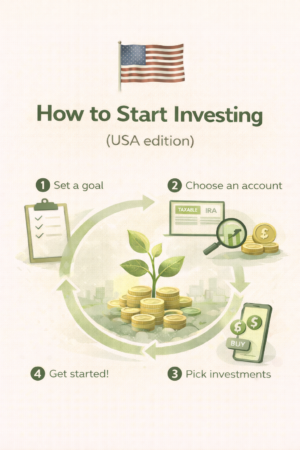
In this guide we’ll look at the three most common types of investment accounts available in the USA including Roth IRAs, Traditional IRAs and Brokerage accounts.
Brokerage Account, Roth IRAs, and Traditional IRAs – What’s the Difference?
If you’re looking to invest your own money in the USA, there are three types of accounts you need to be aware of. Fundamentally, they all do the same thing; they are accounts that allow you to deposit cash, and subsequently by stocks and shares. The difference between the three is the impact of tax.
Before we get started going through the steps on how to set up one of these accounts, let’s first cover off exactly what they are, so you can ensure you pick the right one for investing.
Brokerage Accounts: A standard brokerage account can be used to hold any investment type and has no limits as to how much money you can deposit and invest. The down side is that you are potentially liable to all types of tax including: income tax on dividends and interest, short term or long term capital gains tax, Net Investment Income Tax (NIIT) (for high earners) and potentially even state taxes.
Roth IRA: The Roth IRA is a tax free investment account where you deposit money that you have already paid taxes on. There is no income or capital gains tax on anything earned in a Roth IRA and should be the go to tool in your investment arsenal. Those under the age of 50 can deposit up to $7,000 per year, and those over 50 can deposit up to $8,000 per year. Generally, you cannot withdraw from the account until age 59½ without there being a penalty.
Traditional IRA: This is another useful tool for retirement planning. Any money added to a traditional IRA is tax deductible, and you pay income tax when you draw down in retirement. Annual contribution limits are the same as a Roth IRA, and you also cannot draw down until age 59½ without penalties.
Setting Up an Account
Now we’ve covered the basics, let’s look at how to actually get an account opened to allow you to start investing.
Choose your account type
The below table provides a summary of the three accounts mentioned above. In general, the Roth IRA is your go to account, since it is preferable to pay tax today, since you are then unaffected if income tax shoots up over the coming decades. It also protects you if you happen to make huge gains on your investments.
| Goal | Best Account | Why |
| Back up if your IRAs are maxed out | Brokerage account | Great flexibility and no limit, but heavy tax implications. |
| Retirement planning tool | Roth IRA | Can grow your money and reap the tax free rewards at retirement. |
| Retirement planning tool | Traditional IRA | Tax deductible, can lower your income tax band now. |
What You Need Before You Start
Before you get started with the account opening process, there are a few things you will typically need to have to hand:
- Social Security Number (SSN)
- Government-issued ID
- Proof of address
- Bank account information for funding
- Employer details (for certain IRA setups)
- A smartphone for two-factor authentication
A lot of platforms will give you instant approval and same day trading, others may take 24-48 hours for approval.
Setting Up Your Account
- Choose your platform: When selecting an investment platform, consider the following:
- Fees – how does the platform charge their fees? Is one platform’s charging model more beneficial than another’s? (Eg. fixed cost versus percentage).
- Ease of use – how intuitive is the platform? Is it clear how to navigate and set up an account? Do they have useful information guides? Do they have a call centre to get help?
- Opening your account: Once you have chosen a platform, opening an account should be very clearly sign posted. Once you have located the account opening section of the website, select the type of account you want to open and follow the steps on screen.
- Verify your identity: Upload any ID documents and proof of address requested by the platform.
- Link up your bank account: You will be asked to add your bank account details to aid withdrawals.
- Fund the account: With the account created, the next step is to add cash to invest.
- Pick your investments: With your account set up and funded, the next step is to invest. Ensure you spend time thoroughly researching or seek professional advice if you are not sure where to start. Most platforms will have a wide range of information and will likely suggest investments that most closely meet your needs.
Investing Sustainably
If sustainability is at the heart of your investment strategy, then it is wise to pick an investment platform that has dedicated information on sustainable investing and suggests suitable investments. Types of sustainable investment options include:
- Mutual funds: Pick mutual funds with a specific ESG focus. Do your due diligence and check common data providers like Morningstar to see if the fund has an ESG rating (a score above 75 is classed as excellent). Look at the fund’s underlying holdings – this will let you see if the fund is truly focused on actively investing in companies driving the green transition.
- Exchange Traded Funds (ETFs) are low cost exchange traded funds. Look for ones that focus on specific investments in renewable energy or other green initiatives.
- Impact Investing Funds: Some funds actively aim to deliver measurable impact either socially or environmentally whilst making profit. This branch of sustainable investing is known as “impact investing” and actively tries to make a difference.
Stewardship is another key factor to look for. Does the platform you are investing in actively engage with companies they are investing in and encourage others to to act sustainably? When picking an investment platform or fund, this is something to pay particular importance to. Whilst some will actively encourage better sustainability in the industries, others will not at all.
Conclusion
We’ve now covered all the basic mechanics of setting up your investment account. Remember, if you are planning to invest your money in something, take the time to understand it. Understand the different types of investment accounts, how your platform works, and the different types of investment options available to you. When it comes to investing, knowledge is power, and without research, and learning from those who have experience, you could quickly find yourself losing money either through unnecessary fees or simply making bad investment decisions.