The most useful three-letter acronym you didn’t learn in school.
If you’ve spent any amount of time looking for the best investments to buy, you have likely seen the term ETF appear. ETFs are everywhere, from blog posts to investment platforms, web forums to tv money shows. Everyone seems to be talking about them as if they are the best thing since sliced bread and an absolute essential tool in your investment arsenal.
But what actually is an ETF? Why are they so popular?
In this article we’ll break down exactly what an ETF is and why they are so popular with retail and professional investors alike.
1. ETF: The One-Sentence Definition
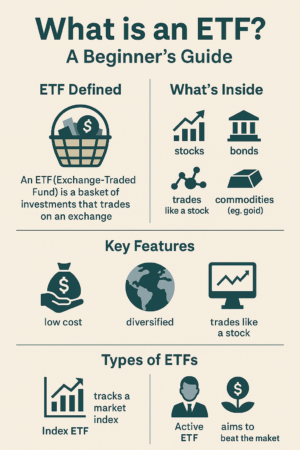
An ETF (Exchange Traded Fund) is a diversified basket of stocks and/or bonds that can be traded on exchange. It is very similar to a mutual fund, but being traded on exchange is the key differentiator which we shall discuss shortly.
In the same vein as a mutual fund, an ETF provides instant diversification, and can be passive or managed actively by a fund manager.
2. What’s Inside an ETF?
An ETF is a basket of investments. The type of investments held in the ETF can vary, and may mix and match depending on the strategy of the ETF. Common examples include:
- Stock ETFs (diversified by location and/or theme)
- Bond ETFs (government and/or corporate)
- Commodity ETFs (Precious metals etc)
- Mixed asset ETFs (stocks/bonds)
When picking an ETF, it is critical to ensure that its strategy aligns with your investment goals and risk tolerance.
3. Why Are ETFs So Popular?
On the surface, an ETF might seem like any other mutual fund – a basket of investment with a defined strategy, managed either passively or actively. But there are some key differences that make them increasingly popular, including their simplicity, cost and availability.
- Simplicity: ETFs are readily available from investment platforms. Buying one gives you instant diversification, reducing the need for careful and risky stock picking.
- Cost: Typical costs of ETFs are extremely low, depending on whether it is passively or actively managed.
- Passive/index stock ETF: 0.05% – 0.25%
- Passive/index bond ETF: 0.10% – 0.40%
- Actively managed ETF: 0.40% – 0.63%
- Availability: ETFs are traded on an exchange like a regular stock. This means that they price intraday and can be traded regularly. This is a key difference to a mutual fund which only prices once a day.
4. Index ETF vs “Active” ETF
When buying a fund, it is important to understand the difference between investing in “active” vs “passive” or “index” funds. This can often confuse beginners, but it is critical to understand the difference.
Let’s break it down.
Index (Passive) ETF
This is the most common type. An index ETF does not try to beat the market, but rather attempts to match it by following, and therefore buying shares in, companies that make up a given index, where an index is a prescribed list of stocks/bonds.
Common indexes include:
- FTSE 100
- S&P 500
- MSCI World
Index ETFs are cheap, and perform consistently in line with the market. Because of this fact, index ETFs often form a significant part of an investor’s portfolio.
Active ETF
An active ETF requires a professional fund manager (usually backed up by research staff) to actively pick the stocks that make up the ETF. The manager aims to beat the market. Sometimes they do, sometimes they don’t.
Because of the additional overheads, actively managed ETFs (or any active fund for that matter) are more expensive. The cost can be seen in the fund’s annual management charge (AMC) displayed in the funds literature.
5. How ETFs Make (and Lose) Money
ETFs make and lose money in the same way any other stock or bond would. Money can be made by:
- Capital appreciation: the unit price of the ETF going up, therefore increasing the value of your holding.
- Dividends: for stock holdings, the ETF will pay out income to shareholders in the form of a dividend.
- Interest: Bond ETFs will pay out regular interest payments to holders.
Of course, the unit price of the ETF may go down as well as up. This decreases the overall value of your holding. If you sell while the price is down, then you realise this loss.
6. Accumulating vs Distributing
Another key piece of jargon to understand when buying an ETF (or any other fund) is the difference between an “accumulation” fund or a “distribution/income” ETF or fund. The decision into which shareclass you purchase will largely depend on your overall goals and time horizon.
Accumulating (ACC)
When you buy accumulation units, any dividends paid out by the ETF are automatically used to buy additional units. This can be beneficial for long term investors since there is no effort required to reinvest the dividends. This quietly increases your year on year portfolio performance which can be significant over the long term.
Distributing/Income (DIS/INC)
Conversely, a distributing ETF will pay out dividends in the form of cash directly to you. If a goal of your investment portfolio is to generate income (ie. money to live off) then this can be extremely useful.
In the US, most ETFs are distributing in nature, and therefore this is one less thing to worry about. However in Europe, it is extremely common for ETFs to have both an accumulation and income share class, so investors must think carefully about the correct choice for their portfolio.
Final Thoughts
ETFs are essentially a more modern equivalent of mutual funds, with the key difference being that they trade on exchange and price throughout the day, not just once a day. Whilst there are arguably additional minor differences between mutual funds and ETFs, if what you’re looking for is an index fund, then both can do the same job.
The bottom line is that ETFs are a simple, low cost investment option that provides the essential diversification an investment portfolio needs.