Capitalism is the cornerstone of western civilisation. It is a system that allows private ownership and rewards innovation with the ability to profit. This powerful combination has led to the rapid development across all areas of life, from farming, to engineering, to medicine all of which have contributed to the rise in living standards of many populations.
However, the cost of this rapid development has led to the deterioration of the planet in an equally dramatic fashion, and can be clearly seen through climate change, loss of habitat and biodiversity, and social inequality.
This leads us to the question, is capitalism capable of driving the green transition?
The Earth’s Problem with Capitalism
The basic model of capitalism is that as production and consumption of goods increase, so does the gross domestic product (GDP) or a country. This could be shown in the following simple equation:
Production of goods + Consumption of goods ∝ GDP
The overall goal of capitalist nations therefore, is for a continued increase in production of goods which can be sold both domestically and internationally and increase the GDP of the nation. There is a fundamental problem with this model, as it works on the basis that the resources available to produce goods are infinite, and therefore the ability to raise GDP is infinite. The reality however, is that we live on a planet with finite resources and if the goods being produced relies on a resource that is finite and cannot be replaced, then it will run out.
Beyond the use of the Earth’s resources, capitalism over the last two hundred years has also cared little for impact on the environment. Damaging the environment through production of goods or draining the Earth of limited resources have not been factored into the equation above, largely due to the fact that our planet can not send an invoice for using its resources or damaging the environment. Well I have news for you; the Earth is finally sending its invoices, and it is in the form of climate change and more regularly occurring natural disasters. As we move forward over the coming decades, capitalism must work under this new equation:
(Production of goods + Consumption of goods) – Planetary impact ∝ GDP
Failure to take into account the debt we owe the planet will set us on a rapid course of self destruction.
Capitalism Must Adapt
Reform or die? We are at a critical point where the western economy needs a fundamental shift. Here we discuss the options available.
Reform
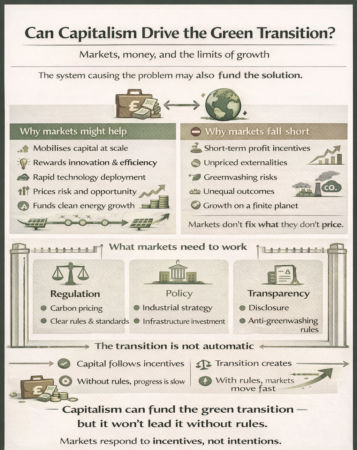
In order to reform, the capitalism equation must be altered to price in the adverse effects on the climate. This idea of “green growth”, is about allowing capitalism to continue, but in a way that does not destroy the planet in the process, and ultimately for it to bring about a green revolution.
This will require a fundamental change in the way the world is run. Pollution needs to be priced in, and mechanisms established to reward firms that reduce emissions and operate sustainably. There needs to be a move away from short term profit to long term value.
A key example in the UK would be our privately owned water companies that prioritise short term returns to shareholders above long term investment into infrastructure. The result? Insufficient capacity in the water supply to provide unrestricted safe, clean drinking water to parts of the population. An additional impact is the dumping of sewage in the UK’s rivers causing a direct threat to wildlife and residents. This is the reality for many UK residents where private owners of critical infrastructure care little beyond profit. I highlight this because it is a relevant example of where capitalism has the opportunity to create a better planet, but it may take a heavy hand to get it there.
Abandon Capitalism
Critics argue that the green transition is fundamentally in opposition with capitalism. The belief is that you cannot continue to pillage the planet whilst becoming greener, and that a different set of bench marks beyond increased GDP are more important. Carefully managing the world’s natural resources, making ecosystems and habitat key factors in the equation when delivering products, are fundamentally more important than simple profit to a small minority of individuals.
The aim of this isn’t necessarily about being socialist or anti-capitalist. It’s about a change in mindset that realises the current system does not work and private companies cannot be trusted to do what is right for the good of the planet. It’s about obtaining a balance where people and nature can thrive and be content, rather than about personal gain.
Value versus Profit
The most pragmatic outcome will need to be some kind of hybrid system. Ambitious individuals can drive fundamental changes in society more efficiently than a government can, but they need to be rewarded for their efforts. This cannot come at any cost. Governments need to carefully consider how they hold private companies to account and re-design the playing field to ensure environmental impact is taken into consideration. If done right, companies can continue to drive the change the world desperately needs and have a positive impact on the planet. Whilst we could list the different ways this could be achieved, in the most simple terms it comes down to one fundamental change; deliver value, not just profit.
Companies must steer away from delivering pure profit for shareholders, and instead focus on value for customers and balancing the impact on the environment. Failure to do so (such as the UK water company scenario) should face serious consequences rather than governments turning a blind eye. Social and environmental impact should be mandatory in the GDP equation. If companies wish to profit, they cannot do so at the expense or risk of either people of habitat. This is similar to point one, the key difference however is here we are talking about companies actively factoring the expense of mitigating negative impact into their budgeting.
Conclusion
If the system can be re-wired so private companies account for carbon but are still rewarded for innovation and productivity, then yes, capitalism can adapt and drive the green transition. This re-wiring can only happen if there is a fundamental change in mindset, that it becomes the norm for companies to embed sustainability within their DNA and focus on value, not just profit.
Capitalism is a relentless beast that will continue to chase productivity, growth, and profit. But with the right rules and guidelines, the right taming, it could be used to drive sustainable change at a rate far beyond any government could deliver on its own. Capitalism doesn’t need to die, it needs to evolve.