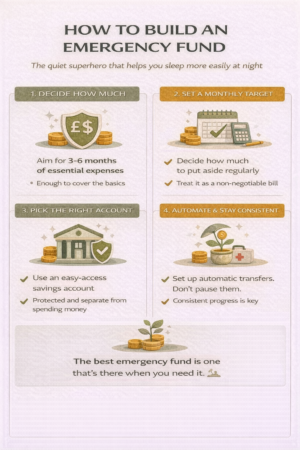
The quiet superhero that helps you sleep more easily at night
When it comes to your finances, there are many topics that can wait until one afternoon whilst you’re sitting comfortably having a coffee. You know the type of afternoon I mean. The ones where you can relax and have time to mentally prepare yourself to dive into some back to school style learning.
When it comes to an emergency fund however, it cannot wait. It is simply too important, and having an emergency fund in place, or not, can be life changing. Life is unpredictable, the cost of living shows no signs of decreasing (or even staying still), therefore, you need to be prepared for whatever life throws at you.
In this article we’ll cover what an emergency fund is, how to build one, and when to use it (and when not to!).
1. What an Emergency Fund Actually Is
Very simply, an emergency fund is a cash buffer, safely tucked away in a savings account somewhere to be used for unavoidable expenses when you have no other cash available. It is your ultimate back stop. Examples of unavoidable expenses can include:
- Your boiler breaks down
- Your pet gets sick (and you don’t have insurance)
- Your car needs an expensive repair
- You lose your job
These scenarios are outside of your control, so you must have cash available to cover them should they unfortunately arise. Some examples of non-emergencies that you should not use your emergency fund for include:
- A last minute city break
- New clothes
- Treating yourself (just because)
It really is very simple. Have enough cash stashed away to cover unexpected life expenses that you otherwise could not afford – and don’t touch it otherwise!
2. How Much Should You Save? (The 3–6 Month Rule)
As a general rule of thumb, you should aim to have six months of cash savings to cover essential expenses. This doesn’t necessarily need to cover your current lifestyle (although there’s certainly no harm saving extra), but it must cover all the bare necessities that you must pay. This includes:
- Rent/mortgage
- Property/council tax
- Insurance
- Energy bills
- Groceries
- Paying off minimum monthly payments of any debts.
IMPORTANT: If you find yourself in a situation where you have lost your job, and there is huge uncertainty around where your next paycheque may come from, speak to your mortgage lender, energy company and local authority to see what they can do. Mortgage lenders often offer mortgage holidays for this situation, and energy companies can sometimes help out too, you just have to ask.
Your lifestyle also needs to be carefully considered – this will impact how much you have in your emergency fund. Consider the following unforeseen expenses you would be faced with if you lost your job:
| Scenario | Unforeseen Expenses | Emergency fund |
| Young & single, no mortgage could move in with parents, could easily find another job | – Unforeseen car repairs- Short term job loss | £3,000/$3,000 |
| Single or main earner in a relationship with a mortgage. No option to move in with parents. | – Mortgage, bills, groceries- Boiler repair- Roof repair- Car repairs | Minimum 3 months salary |
| Married, sole wage earner, young family with mortgage. May struggle to find another job at currently salary level. | – Bigger Mortgage, bills, & groceries- Insurances- Boiler repair- Roof repair- Car repairs | 6 – 12 months salary |
The table above is simple, but it dramatically shows the impact your current lifestyle has on the demands of an emergency fund. The more responsibilities you have, the bigger your fund has to be.
3. Where to Keep Your Emergency Fund
The key to your emergency fund is that it needs to be immediately accessible, safe and still earn you some interest.
Best Option: Open a dedicated high interest, easy access savings account. There are numerous options for this depending on where you live in the world, but keeping an emergency fund to hand with an FDIC/FSCS (US/UK) backed bank is non-negotiable.
Not so good options: Do not keep your emergency fund invested in stocks and shares. Whilst stocks and shares are an essential part of planning for the future, you need an initial buffer that is there no matter what. Start with 6 months worth of cash savings, then move onto investing.
Worst option: Crypto currencies are perhaps the worst option, given their volatility.
4. How to Build your Emergency Fund
Building an emergency fund doesn’t happen on its own and requires some commitment to get you there. However, with a little bit of discipline and a few simple steps, you’ll have built up your fund in no time. Here’s some simple steps you can follow right now.
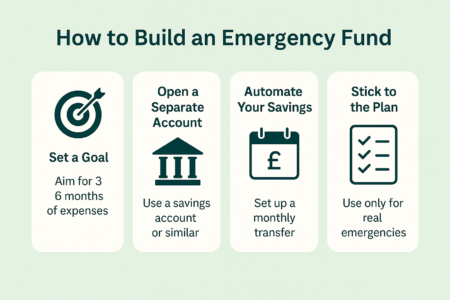
Step 1: Know Your Number
Work out exactly how much you need per month to cover your essential expenses, then times it by six. This is your target.
Step 2: Open a Separate Account
Open a separate, dedicated savings account in order to clearly segregate from your day to day spending. Shop around for a good interest rate. Hopefully your money will be sitting there for a long time so make sure to earn some interest!
Step 3: Automate Your Savings
Set a monthly transfer from your main checking account — £100/$100 per month is a good place to start. (If you have a partner who also works, encourage them to do the same!).
Step 4: Add Boosters When Available
Whenever you come into unforeseen additional cash, make it a habit to top up your emergency fund, rather than going out and treating yourself. Examples might include:
- Work bonuses
- Tax refunds
- Cash birthday gifts from family
- Selling unused items (eg. on Ebay or Facebook Marketplace)
Step 5: Protect, Don’t Perfect
Your emergency fund doesn’t need to be perfect, but it does need to be there!
The below illustrates the steps just discussed:
5. Common Mistakes
Here are some common mistakes people make in lieu of starting an emergency fund.
Waiting to earn more
Waiting to earn more before you start saving? Unfortunately, this excuse will never get old. A combination of inflation, plus lifestyle creep, means you will forever be “waiting to earn more” before you start saving. Start small, start now!
Using a credit card as an emergency fund
Credit cards are a loan, not an emergency fund. When you spend on a credit card, if you cannot pay it back when the balance is due, you’re looking down the barrel of some hefty interest…this is how you start getting into massive credit card debt.
Investing before saving
Cash is not exciting and returns are poor, whilst stocks and shares can have massive returns. Whilst this is true, stocks and shares can also have losses. Build up a cash fund first. Once you have built it, set it to one side, and then focus on investing!
Final Thoughts
Emergency funds are incredibly practical and will shield you when things go bad. But beyond the obvious, there are a number of other invaluable benefits:
- Sleeping better at night
- Reduced money anxiety
- Increased confidence for future wealth building
On your path to building wealth, the emergency fund is your first step. It may not be as exciting as investing, and seeing the effects of compound interest, but it’s the basis of personal financial stability. Start small, and start now. Once it’s built, it’s built and you can move onto the next chapter of personal financial wealth.