From a young age and throughout adulthood, learning how to budget financially is compulsory. We learn to control the balance between the income we earn and the money we spend, with the aim of increasing our overall capital and avoiding debt.
But while we understand the importance of financial budgeting, we are not taught the importance of carbon budgeting, let alone how to do it. Just as financial debt can rapidly compound and spiral out of control, carbon debt is just as damaging if we do not control it collectively.
In this article, we shall examine what a low carbon budget is, why it is important, and how to live and invest with one.
What is a Carbon Budget?
Humans collectively emit over 40 billion tonnes of carbon every single year. Carbon Dioxide (CO2) acts as a greenhouse gas, which hangs around in the sky and then traps heat inside the Earth’s atmosphere. Therefore, the continuous increase of carbon dioxide added to the atmosphere every year leads to the planet gradually, and consistently, getting hotter and hotter every year leading to global warming. This leads to rising sea levels, increased acidity in the oceans (CO2 is acidic) and more frequent and more extreme weather events (floods, droughts etc).
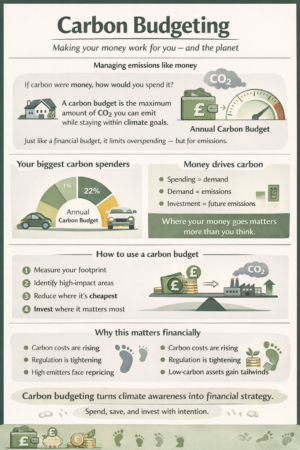
Whilst governments and businesses can do a lot to manage the amount of carbon emitted, we as individuals also have a huge part to play, and collectively can have a dramatic effect in reducing carbon emissions. Carbon budgeting is about understanding how much carbon we as individuals omit to the atmosphere each year.
The goal is simple: to understand our carbon footprint, and then work out how we can change our habits to dramatically reduce it without affecting the overall quality of our lives.
Your Carbon Footprint
Your own carbon footprint is made up of the following:
- Energy usage (gas and electricity etc)
- Transport (car, buses, trains)
- Food
- Travel (flights)
- Lifestyle purchases
There are free tools that exist to calculate the amount of carbon you emit. Tools such as carbonfootprint.com have been specifically made to do just that.
Once you have worked out where your largest carbon expenditure is, the next step is to cross examine these against your largest financial expenditure. This is an exercise in data gathering, as once you understand where your biggest expenditure is, you can begin to investigate if there are ways to minimise carbon expenditure by making simple changes without affecting your lifestyle. Let’s examine some practical options…
Sustainable Banking
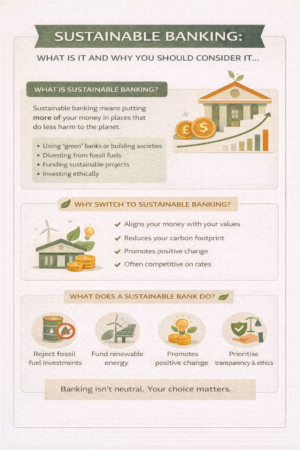
Your biggest carbon emissions are likely generated not from what you spend your money on, but rather, where you save it. When you deposit money in a bank, the bank does not simply sit there idly. Instead, then either invest it, or use it to facilitate additional credit in the form of loans. If your bank lends to or invests in non-sustainable companies (such as fossil fuels companies), you are indirectly funding them.
In the article “Sustainable Banking: What is it and why you should consider it…” we looked at this topic in more detail. Quite simply, if you hold your money in a bank focussed on sustainability, your money will be used to support companies supporting the green transition as opposed to those against it.
Spending Sustainably
The next thing to look at is how and where you spend your money. We called out key expenditures above that contribute to your carbon footprint, now let’s look at some simple ways to reduce carbon emissions.
- Energy:
- Switch to an energy company that aims to produce electricity from renewable sources
- Upgrade your appliances to more efficient ones and reduced your energy consumption (even the nimble light bulb can make a massive difference)
- Transport:
- Use public transport where possible
- Upgrade to an electric car and charge it in a sustainable way
- Food: Reduce meat consumption for a more plant based diet
- Lifestyle: Recycle, repair, reuse, re-sell – don’t just bin things unnecessarily
Sustainable Investing
Use a sustainable investing platform to invest in a sustainability focussed investment portfolio. Remember to hold investments in a tax efficient wrapper!
UK: ISA, SIPP
USA: Roth IRA, 401(K)
Conclusion
I hope from this short article that you can begin to see that there are many opportunities to make a significant dent in your carbon footprint without any detriment to your current lifestyle. But you are probably thinking to yourself, “how can I as an individual possibly make much difference?”. As an individual you are right in that you cannot significantly change the world. However, if people are properly educated on the subject, and are willing to shift their mindset to realise that an individual’s reduction in carbon output is not about deprivation, but about re-adjustment, then maybe enough people can wake up and change their behaviour.
The world now realises the benefits of proper financial education. But now, as we are already a quarter of the way through the 21st century, we also need carbon education to understand the impact of the financial decisions we do (or do not) make. Finance and climate impact are no longer separate topics, they are intertwined with one another and we must adapt our decision making process when spending and saving. Do this small change and we can make a big difference.