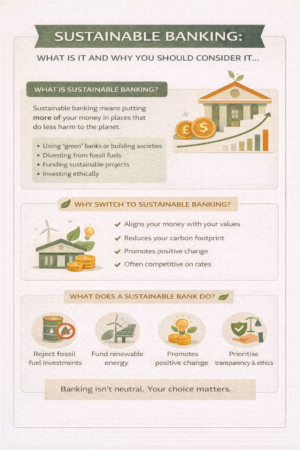
We have a problem. Over recent years it has become very trendy for businesses to brand a product or service as “green”, “sustainable”, “ethical” or “responsible”. Businesses know that consumers are becoming more conscious about how they spend their money and are doing what they can to win your business by pretending to be green. When a firm pretends to be green without backing it up with action, it is known as “green washing”.
Governments have noticed this trend and have stepped in. Enter the “Green Taxonomy”. The Green Taxonomy is effectively a dictionary that provides definitions to words or phrases that could be used to make a product or service sound green.
At the time of writing, the USA has not yet developed its own taxonomy, and the UK’s version is at the final stages of consultation. Whilst many other countries either do or are developing their own taxonomies, we shall examine further the European Union’s (EU) green taxonomy which was launched in 2020.
What is the EU’s Green Taxonomy?
At its heart, and as alluded to above, the green taxonomy is a classification system that provides investors and companies clear guidance around what potentially sustainable language really means. It is a common framework used throughout the EU to ensure consistency of language with regard to sustainability.
By implementing the taxonomy, it helps eradicate green washing, and build trust in those companies that truly are sustainable.
At this stage, you are probably thinking, where do I find this dictionary that I’m referring to? The dictionary, or taxonomy can be found here. The specific definitions start at Chapter 1, Article 2, which begins roughly one third of the way down the page.
https://eur-lex.europa.eu/legal-content/EN/TXT/?uri=celex%3A32020R0852
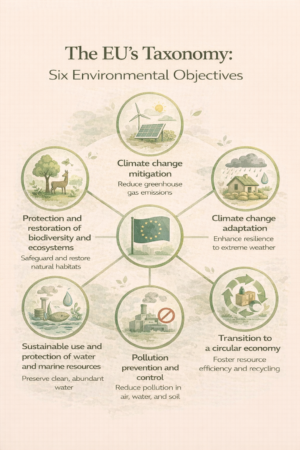
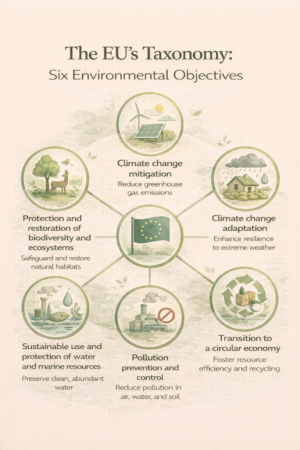
The EU’s Taxonomy contains six environmental objectives, as well as four conditions an activity must meet in order to be taxonomy aligned. Full details of these can be found on the EU Taxonomy Navigator and are summarised in the infographics below.
The six objectives:
The four conditions:
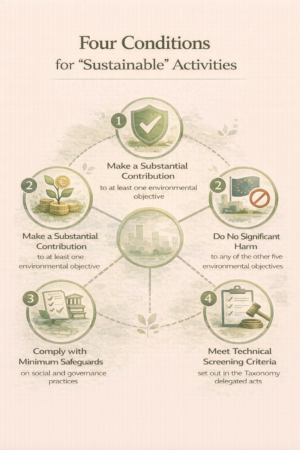
From the above we can clearly see, a new wind farm definitely fits the bill, a new coal mine does not.
What it means for investors and companies
With the overall plan to make the planet more sustainable, the taxonomy provides companies with a clear frame of reference, and can support them in making the green transition. In turn, it provides conscious investors a tool to easily identify these companies, and therefore ensure the flow of money to them. This change, whilst well intentioned, does not come without its challenges.
For companies, there will be an increase in reporting requirements. They will need to obtain and analyse data in order they align with any definitions they claim to align with from the taxonomy. This ultimately increases operating costs and complexities, taking cash and effort away from running their core businesses.
Professional investors such as fund managers also face a significant impact when creating investment products. Funds they create will need to demonstrate how their portfolio aligns to the taxonomy. This again means a huge additional effort in data and reporting requirements. This increases the costs and complexity of running funds to the point where it becomes unviable for sub-scale fund managers to enter the market. Both the UK and the EU have brought out new “labelling” regimes that aim to make it easier for retail investors to identify sustainable funds. (In the UK this is Sustainability Disclosure Requirements (SDR) and in the EU it’s the Sustainable Finance Disclosure Regulation (SFDR)).
Individual investors are the real winners, since they will have a clear mechanism to identify green funds that they wish to invest their money in. That’s the whole point, to more easily allow the flow of money into green funds to improve the health of the planet.
Conclusion
The Green Taxonomy is not a box ticking exercise, or regulation for regulation sake. It has been designed to build a foundation, a standard, that provides clear guidance to companies and professional investors who wish to align their practices to the green transition. It can also be used to hold them to account.
The taxonomy is not the finish line, it’s the start of something much bigger. It’s the framework that will aid the transition to a greener economy, making it simpler for individuals to ensure their money flows where it really matters.