When someone mentions sustainable living, the first thing that usually springs to mind is probably solar panels, electric cars and reusable cups. What probably doesn’t come to mind is your bank account. Yet our bank accounts could very quietly have a profound impact on sustainability. In this article we’ll look at what sustainable banking is, and why you should consider it.
When you deposit your money into your bank account, the common misconception is that it sits there, tucked away safely at night waiting for you when you need it. However, the reality is that banks actively use their customers’ money to either provide loans, or invest in the stock market, subsequently making profit for themselves. The question is then, who are they providing loans to and what are they investing in? The truth is, it could be anything from coal mines to wind turbines.
The question needs to be therefore, why wouldn’t you consider using a sustainable bank?
Why it matters where you bank
Despite many major banks publicly making net zero pledges, the reality is that over the last decade, trillions of dollars have poured into fossil fuel related projects. If your bank is one that finances such projects, then every pound, dollar or euro you deposit may well have helped fund them. We are all, indirectly, part of the global financing machine for international corporations.
I’m not calling this out to make you feel guilty. On the contrary, the goal here is to raise awareness that where we bank, and how banks use our money matters. Switching to a sustainable bank is not a symbolic gesture. If enough people move their money away from banks that fund projects not aligned to our own values, and instead, work with banks focused on sustainable projects, we can change the entire flow of capital around the world. Our money can then be put to work funding companies focused on building a green, low carbon world.
What makes a bank sustainable?
It takes more than fancy logos and a green themed website to be sustainable. When companies try to make themselves look “green” without backing it up with real action, this is known as “green washing”. Whilst regulators are re-writing the rulebook in order to crackdown on this and bring about transparency, as consumers there are things we can look out for when deciding on whether to move to a “sustainable” bank.
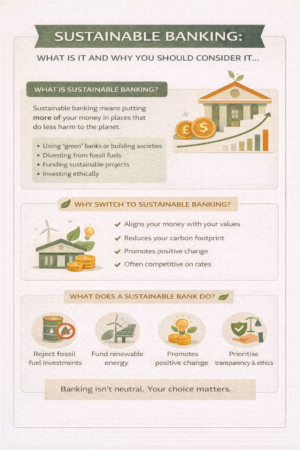
- Transparency, transparency, transparency: When a bank’s unique selling point is sustainability, they will want everyone to know about it. This means they will actively tell you what they are, and more importantly what they are not doing:
- They don’t lend to fossil fuel related firms, arms manufacturers, companies that violate human rights, companies associated with deforestation etc.
- They do produce annual reports disclosing exactly who they do lend to.
- They do actively invest in companies driving the green transition such as those focusing on renewable energy and organic farming.
- Responsible operations: They try to have minimal impact on the planet when running their own businesses. This means trying to use renewable energy, recycling well, and looking after the well being of their own staff.
- External verification: Lastly, look for third party recognition from companies including:
- B Corp certification
- Membership of the Global Alliance for Banking on Values (GABV)
- UN Principles for Responsible Banking signatories
Examples of sustainable banks
Below are some examples of recognised sustainable banks across Europe and the USA:
- UK: Triodos Bank — a leading ethical bank that publishes details of every loan that it makes.
- The Co-operative Bank — a long standing bank with a strong focus on an ethical approach.
- EU: Tomorrow Bank (Germany) and Bunq (Netherlands) — digital-first, sustainability-focused challenger banks.
- US: Amalgamated Bank — one of America’s oldest socially responsible banks.
Choosing a sustainable bank
Twenty years ago, changing banks involved physically going into your bank, and completing a lot of paper work in order to transfer to a new bank. However, in 2025 most countries have straightforward automated switching services that make transition a piece of cake, even transferring over any direct debits you may have set up. The good news then is administration is no longer the issue it once had been.
Before switching banks, it is wise to conduct your own independent research in order to locate and then verify suitable green banks. The good news is, there are a number of websites whose purpose is to do the hard work for you.
Bank.Green is a fantastic website that lets you search banks across the globe. It returns a detailed list of banks with top level green stats including whether they are fossil free, then allows you to drill down further, with a more detailed overview of what makes the bank sustainable or ethical, and even lists any external accreditations it may have.
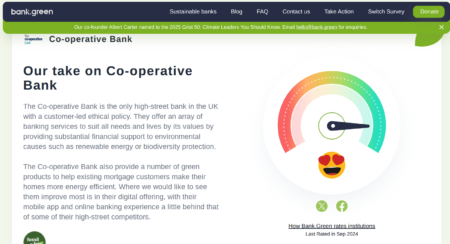
Screen shot from Bank.Green
Once you’ve decided on your chosen current or savings account, the next task is to open an account and move your money. Many countries have automated switching services, so should you wish to move all of your day to day banking and any existing direct debits, then these transfers will handle this for you, usually free of charge.
The financial case for green banking
Making the move to green, sustainable banking stretches beyond making a difference to the planet, it actually makes solid financial sense too. As time moves forward, and the green transition picks up pace, those banks tied to fossil fuels, or are perhaps less ethical are likely to face significant challenges. As the shift away from fossil fuels continues, banks heavily invested in these companies may soon find themselves with portfolios of assets where share prices are dropping, or worse, become illiquid. Regulators will only increase regulation and heighten the standards expected from our financial institutions. The bottom line, focus on where banking is going, not where it’s been.
Sceptics might argue that maybe sustainable banks don’t have the best apps or the best interest rates, so why bother changing? This is a valid question. The answer? There’s no need to throw your eggs all in one basket if it doesn’t work for you. Diversify. Use a bank with your favourite app for your day to day spending, but keep your savings in a sustainable bank. In this way, it can be put to work for good while you sleep.
Conclusion
How we collectively bank, spend and invest shapes the economy. If enough people begin to change up their lifestyles and think green, then the flow of money in the economy will change for the better, flowing to businesses trying to make a positive change in the world.
The beauty of making a change in your banking is how simple it is. Unlike having to remember a reusable coffee cup, or buying solar panels, your money can make a difference to the planet while you sleep – all at no extra cost.