In this guide we’ll look at the common types of investment accounts available in the UK including ISAs, SIPPs and GIAs as well as guiding you through how to actually set one up and how to invest.
ISAs, SIPPs, GIAs – What’s the Difference?
When you make the decision to begin investing, you are quickly bombarded with a host of acronyms and new words. Before doing anything, it is worthwhile spending ten minutes to understand the basic components of investing. Since the first thing to do in order to invest is opening an account, it makes sense to start with the three main types available.
Fundamentally, ISAs, SIPPs and GIAs all do the same thing. They are accounts that allow you to hold both cash and stocks in them. (You need to deposit cash in the account first, in order to then buy a stock). The difference between the accounts is how they treat tax.
Individuals Savings Accounts (ISA): An ISA is a tax free account of “wrapper”. You put money into something that you have already paid tax on, but then any income or capital gain made on cash or stocks inside the ISA is exempt from any further tax. You can currently put up to £20,000 per annum into an ISA. Junior ISAs, (JISAs) are also available for children under 18 years of age, and up to £9,000 per annum can be deposited.
Self Invested Personal Pension (SIPP): A SIPP is a form of pension account with upfront tax relief. This means that any money put in a SIPP goes in pre-income tax. If you are funding a SIPP with income you have already paid tax on, you’re probably wondering how on earth it works! If you pay £80 into a SIPP, the government will top it up with an extra £20 taking the total deposit to £100. The effect is that you have received 20% tax relief. If you are a higher or additional rate tax payer, you have to claim back the additional 20/25% through a tax self assessment. When you eventually draw down the SIPP (which can be done from the age of 55, going to 57 in 2028), you pay income tax on it then.
General Investment Account (GIA): A GIA is an account with no tax efficiencies. This means any income earned in an account through dividends or interest is subject to income tax (paid at whatever rate you pay income tax). If your stocks go up in value (capital appreciation) and you sell them, you will need to pay capital gains tax on their disposal. The plus side is that a GIA has no restrictions on how much you invest and is completely flexible.
Setting Up an Account
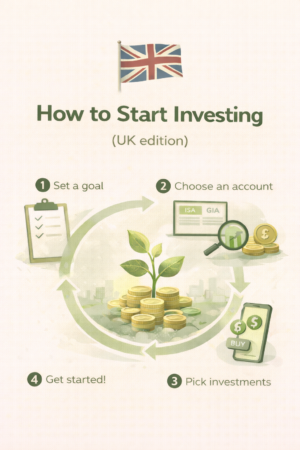
Now you know the basics, let’s walk through the step by step process you need to follow to get that account set up and start investing.
Choose your account type
The first task is to choose the most appropriate account for your needs. The table below provides an overview of each account and why you might need them. Generally speaking, your ISA is your first point of call since it has a great deal of flexibility, and since you have already paid the tax, you do not have to worry if the government increases income tax in the future. The SIPP is next as it is still very tax efficient, followed by a GIA.
| Goal | Best Account | Why |
| Build long-term wealth – tax-free! | ISA | No tax on gains or income, full flexibility |
| Pension purposely designed for retirement planning | SIPP | Free government top-up, but locked until age 55/57 |
| Back up account if ISA & SIPP are maxed out | GIA | No limits and highly flexible, but subject to both income and capital gains tax |
Eligibility
The next step is to determine whether or not you are eligible for each of the accounts. The below table provides s brief overview of the requirements.
| Account | Eligibility |
| ISA | UK ResidentAge 18 or over (under 18 for JISA)Total annual allowance £20 (£9k for JISA)Note: from 2024 you can hold multiple ISAs, as long as you do not breach the limit |
| SIPP | UK ResidentAge 18 or overCan contribute until the age of 75National Insurance Number required |
| GIA | UK ResidentAge 18 or overNo limit on amount you can invest (but subject to income tax and CGT) |
Setting Up Your Account
- Choose your platform: The first job is to choose your investment platform. Things to consider when selecting your platform include:
- Fees – do they charge a fixed amount, fixed percentage or a sliding scale?Do they charge more for automated regular investments? What are their dealing charges? Some platforms for example do not charge to invest in funds.
- Sustainable fund options – do they have dedicated expertise and information on how to invest in green/sustainable funds?
- Ease of use – is the platform intuitive and easy to use? Does it have useful guides? Do they have a call centre where a human being can help you out?
Popular platforms in the UK include: Vanguard, Fidelity, AJ Bell, Moneybox, Interactive Investor, Trading212.
- Open your account: On your chosen platform, click on the “open account” button (or “open ISA” etc. Most platforms will make it very easy to navigate from the open page to the account opening page within a clock or two.
- You will then need to fill in your details. You can be expected to provide:
- National insurance number
- Bank details
- Details of any other ISAs/SIPPs
- Verify your identity: Also be prepared to upload ID. This is not always required! But expect as a minimum to have:
- Passport/Driving license
- A utility bill/bank statement
- Add money: Once opened, you can deposit money. All major platforms will have a very clear “add cash” button or equivalent for you to directly deposit money using a debit card.
- Choose your investments: Now your account is set up and you’ve added money to your account, you’re ready to invest! You must take time to carefully research your investments. Most major platforms will have some kind of research facilities. Index tracking funds are a great option, however are not going to be aligned to sustainability goals. When selecting a platform, look for ones that provide dedicated guidance and recommendations on sustainable investing. Examples of sustainable investments include:
- Global ESG index funds
- Paris agreement-aligned ETFs
- Renewable energy trusts
- Impact funds (climate tech, clean energy etc)
- Regular Investments: With the basics done, another option is to consider setting up a “regular investment”. This works by setting up a monthly direct debit to your bank account, to then automatically invest in your chosen fund/funds. This is great for making small, regular contributions. Caution: Be sure to check if the platform charges for this service. There’s nothing worse than setting up a monthly £50 investment only to find the platform takes £2 as a charge!!
Investing Sustainably
Once you’ve opened an account and added money, the last thing to do is invest. But what about sustainability? How can you be sure what you are doing is going towards funding a new coal mine somewhere? Before starting, there are a few things you can do to ensure your investment has the desired impact.
Platform Due Diligence
Before picking an investment platform, if sustainability is a key objective for you then it would be prudent to do some due diligence on your intended platform to check their credentials. Here are some things to check.
- Does the platform offer a wider range of sustainable options?
- Do they have dedicated information pages to help you navigate the sustainable jargon?
- Does the platform align to sustainable financial regulation?
- Is the platform committed to sustainability? Have they signed up to frameworks like UN-supported Principles for Responsible Investment (PRI)?
- Read user reviews on the platform to ascertain the level of customer satisfaction.
Investment Validation
Next is checking any potential investments. Throughout this website this is a topic we cover in detail, but here’s a quick checklist to ensure any proposed investment fund meets your sustainability goals.
- What is the objective of the fund? Does it avoid “bad” stocks (ethical investing) or actively invest in companies with strong ESG practices?
- SFDR: Is the fund
- Article 6 (not sustainable)
- Article 8 (some ESG characteristics),
- Article 9 (sustainable, measurable objectives).
- SDR labels – does it have one?
- Sustainable Focus (70% ESG focus)
- Sustainable Improvers (focus on companies with potential to be green)
- Sustainable Impact (aims to achieve measurable impact)
- Sustainable Mixed Goals (blend of the above strategies)
- ESG scores – check the fund’s ESG score. Anything over 75 is excellent.
Common Mistakes to Avoid
Here are some common mistakes people make new to investing. Whilst they may seem trivial, it can have a big impact on your returns!
- Investing in a GIA instead of an ISA: When going through the account opening process, you may well open both an ISA and a GIA. Be sure to utilise your ISA first! Do not accidentally fund your GIA and buy stocks in that, as they will be subject to tax. This is an easy mistake to make.
- Not all stocks can be held in an ISA. Your investment platform will have these clearly marked as ISA eligible or not, but is another thing to be aware of.
- Forgetting to set up regular contributions. After doing all the hard work setting things up, make sure you set up regular deposits and put investing on autopilot.
- Overtrading: Another pitfall is trading too often. If you’re being charged every time you deal, this is going to dramatically eat at your returns. Investments take time to appreciate and generate returns, don’t rush things.
- Ignoring fees: Understand that there are a number of different fees involved with investing. Your platform will charge at least one fee for providing custody of your investments, and may charge others, such as for simply having an ISA, for trading, for setting up regular investments. Understand the annual management fee on a fund. Typically for sustainable funds these can be higher as a fund manager may be actively managing the fund.
- Lastly, and as already discussed, check the green credentials of any potential investments.
Conclusion
So there you have it, a simple guide to getting started on your investment journey. Remember, the key to successful investing is education. Take time to educate yourself on the basics of investing, understand different products available to you, how they work, how they are regulated and how much they cost. Time spent learning these foundations will serve you well for the rest of your life and allow you to gradually build wealth, potentially changing the planet at the same time.